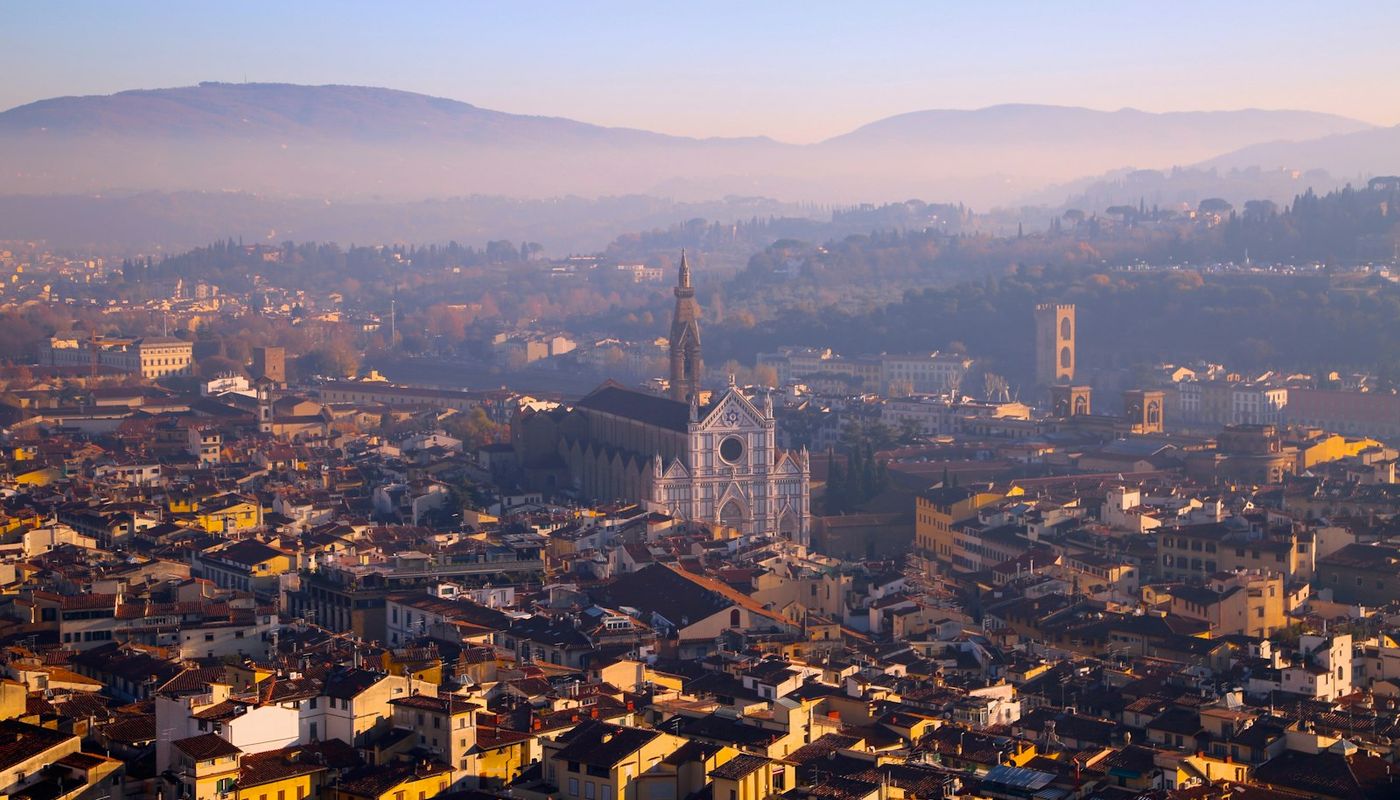
Manifattura Tabacchi, Florence: A Foreign Buyer's Guide to the 2026 Rental Rules
Buying an apartment at Manifattura Tabacchi is straightforward from a legal standpoint. Most foreign buyers face no ownership restriction at all, and the paperwork is the same as it would be for an Italian. What is not straightforward, and what almost nobody selling into this project will lead with, is that Florence spent 2025 and 2026 building the tightest short-term rental regime of any major Italian city, and in May 2026 the city extended it to the neighbourhoods that surround this site.
If you are buying here to live, that is background noise. If you are buying to rent to tourists, it is the single fact that decides whether the numbers work.
What the project actually is
Manifattura Tabacchi is the former state tobacco factory at Via delle Cascine 33-35, in the western wedge of Florence between Novoli and the Parco delle Cascine. It was designed and built by Giovanni Bartoli and Pier Luigi Nervi, who jointly ran the construction firm, with work starting in 1933 and the complex inaugurated on 4 November 1940. Nervi's hand is still visible in the glazed tower of the old recreation building, now the Teatro Puccini. Production ceased on 16 March 2001 and the site sat largely empty for the better part of two decades.
The regeneration covers six hectares, sixteen buildings and roughly 110,000 square metres. The programme splits into about 37,000 square metres of education, offices and co-working, 35,000 of residential, 26,000 of hospitality and co-living, and 11,000 of ateliers and workshops. The vehicle is Manifattura Tabacchi S.p.A., a joint venture between a fund managed by Aermont Capital and CDP's Fondo Sviluppo, after CDP Immobiliare sold its majority stake. Savills handles sales.
The architectural pedigree is unusually deep for an Italian regeneration scheme. The masterplan started with Concrete Architectural Associates, was refined by SANAA, the Japanese practice that took the 2010 Pritzker, working with Studio Mumbai. Current delivery runs through q-bic and Piuarch, with landscape by Antonio Perazzi. Patricia Urquiola designed interiors for Building 7.
The residential piece arrived in stages. Zenit, in the two wings of the entrance building, is 34 apartments across 4,800 square metres plus 1,530 square metres of rooftop, loggia gardens and terraces, with interiors by Quincoces Dragò & Partners, an energy class of A1 or better, a BREEAM Excellent target and a 400 square metre communal roof. It completed in March 2026. Hines has separately invested to build student housing with more than 500 beds. And in March 2026 work began on 39 subsidised apartments on Via Giuseppe Tartini beside the Teatro Puccini, 27 three-bedroom and 12 two-bedroom units over seven floors, a €9 million scheme with €8 million from the Fondo Piani Urbani Integrati backed by Intesa Sanpaolo and Italy's PNRR recovery funds, designed by Piuarch and due in summer 2027. Those units let at 20 per cent below the municipal territorial agreement rate for twelve years before residents get purchase options.
That mix matters to a buyer. A district with students, subsidised tenants, offices and a hotel behaves differently from a pure luxury enclave. It is more likely to have a functioning local economy on a Tuesday in February, and less likely to deliver the scarcity premium that a Duomo-view apartment does.
The rental rules are the real variable
In May 2025 Florence adopted regulations restricting short-term tourist lets inside the UNESCO historic centre. The rules require five-year authorisations, impose a 28 square metre minimum unit size, and block new tourist rentals unless the property was already legally used that way during 2024.
Property managers, trade associations and private owners filed nineteen separate challenges, arguing the rules breached constitutional protection of private property and freedom of enterprise as well as EU services and competition principles. On 13 May 2026 the Tuscany Regional Administrative Court rejected all nineteen. It leaned on an earlier Constitutional Court decision upholding Tuscany's regional tourism law, and held that protecting the urban environment, cultural policy and historic heritage are overriding public-interest grounds. The restrictions are now settled law, not a policy experiment that might be struck down.
Then Florence went further. On 26 May 2026 the council approved an extension of the ban beyond the historic core. The named areas include San Jacopino, Statuto, parts of Rifredi, Le Cure, Campo di Marte, sections of Bellariva and the broader San Frediano area running toward Isolotto, with the perimeter described as reaching from Via Erbosa to Piazza Paolo Uccello. Roughly 35,593 properties in the UNESCO centre plus a further 67,780 outside it fall under restriction, over 100,000 in total.
Here is the part that requires care rather than a confident sales pitch. Manifattura Tabacchi sits immediately adjacent to San Jacopino, which is explicitly named in the expansion, and near the Via Erbosa reference point. Whether a specific building on the site falls inside or outside the drawn perimeter is a question the approved map answers, not a brochure. Before signing anything, ask the notary to check the address against the final approved zoning annex, and get the answer in writing.
Two mitigations apply. The extension covers new short-term lets only, and existing operators have a moratorium until 31 May 2028. After that Florence has signalled an authorisation system that would reduce total tourist rental numbers.
The tax layer tightened in parallel. Short-term rental income can be taxed under the cedolare secca flat regime at 26 per cent, reduced to 21 per cent if you elect it in your return for a single property in the tax period. From 2026, under Article 1 comma 17 of Law 199 of 30 December 2025, letting more than two apartments short-term in a tax period creates a presumption that you are running a business, which pushes you out of the simplified regime entirely. Every let also needs a CIN, the national identification code introduced by Article 13-ter of Decree-Law 145/2023, and platforms and agents must transmit it.
The ownership question, briefly
Italy imposes no general bar on foreign ownership. EU, EEA and Swiss nationals, and non-EU nationals holding a valid Italian residence permit, buy freely. Everyone else is subject to the condition of reciprocity under Article 16 of the preliminary provisions to the Civil Code, meaning your country must allow Italians to buy property there. The Foreign Ministry publishes the reciprocity tables, and Americans, Britons, Canadians and Australians all clear it. We cover the mechanics in detail in our guide to Italy's reciprocity rule.
Practically you need a codice fiscale, an Italian bank account, and a notary. The transaction runs through a preliminary contract, the compromesso, usually with a deposit, then the rogito before the notary. Our step-by-step walkthrough of the Italian buying process covers the sequence and costs, and the IMU, IRPEF and cedolare secca breakdown covers what you pay annually once you own. Note that IMU applies to second homes and non-resident owners, which is most foreign buyers at a scheme like this.
How to think about it
Manifattura Tabacchi is a genuine piece of urban regeneration with institutional capital, serious architects and a delivery record that now includes completed residential stock rather than renders. That distinguishes it from a great deal of what gets marketed to foreign buyers in Italy. Checking whether a developer has actually delivered what it promised is the first thing to establish anywhere, and platforms like Bektu exist to make that delivery history verifiable rather than assumed.
But buy it for what it is. The rental regime means the plausible returns here are from long lets to students, academics and professionals working in the district, not from tourist nightly rates. Long lets in Florence are a real market with real demand and considerably thinner margins. Anyone modelling this on Airbnb comparables from 2023 is modelling a city that no longer exists.
Sources
- Manifattura Tabacchi Firenze: the project
- Manifattura Tabacchi begins work on social housing project, The Florentine, 2 March 2026
- Zenit: 34 new apartments in Florence's Manifattura Tabacchi, idealista
- CDP press release: Manifattura Tabacchi Firenze, social housing works begin (PDF)
- Hines invests in Manifattura Tabacchi regeneration to create student housing with over 500 beds
- Locazioni brevi: la disciplina fiscale 2026, Finanza & Fisco
- Manifattura Tabacchi, Via delle Cascine 35, Florence, Savills listing
Sign up to read the rest
Create a free account to keep reading. It only takes a minute.
Developers referenced
- Manifattura Tabacchi S.p.A. Florence, Italy
- Aermont Capital London, United Kingdom
- Hines Milan, Italy
- Piuarch Milan, Italy
Thinking about Manifattura Tabacchi S.p.A.?
You cannot walk the land from another country. But you can verify the developer. Bektu contacts them on your behalf and sends you a scored report. They never see who asked.
Verify Manifattura Tabacchi S.p.A. anonymouslyThinking about Aermont Capital?
You cannot walk the land from another country. But you can verify the developer. Bektu contacts them on your behalf and sends you a scored report. They never see who asked.
Verify Aermont Capital anonymouslyThinking about Hines?
You cannot walk the land from another country. But you can verify the developer. Bektu contacts them on your behalf and sends you a scored report. They never see who asked.
Verify Hines anonymouslyThinking about Piuarch?
You cannot walk the land from another country. But you can verify the developer. Bektu contacts them on your behalf and sends you a scored report. They never see who asked.
Verify Piuarch anonymouslyMore from Bektu
Stay a step ahead of the wire transfer
Get the occasional note from Bektu on verifying developers before you commit. No noise, just what matters.
We will never share your email. You can opt out at any time.